Popular Searches:
Recommended Posts


Search Results

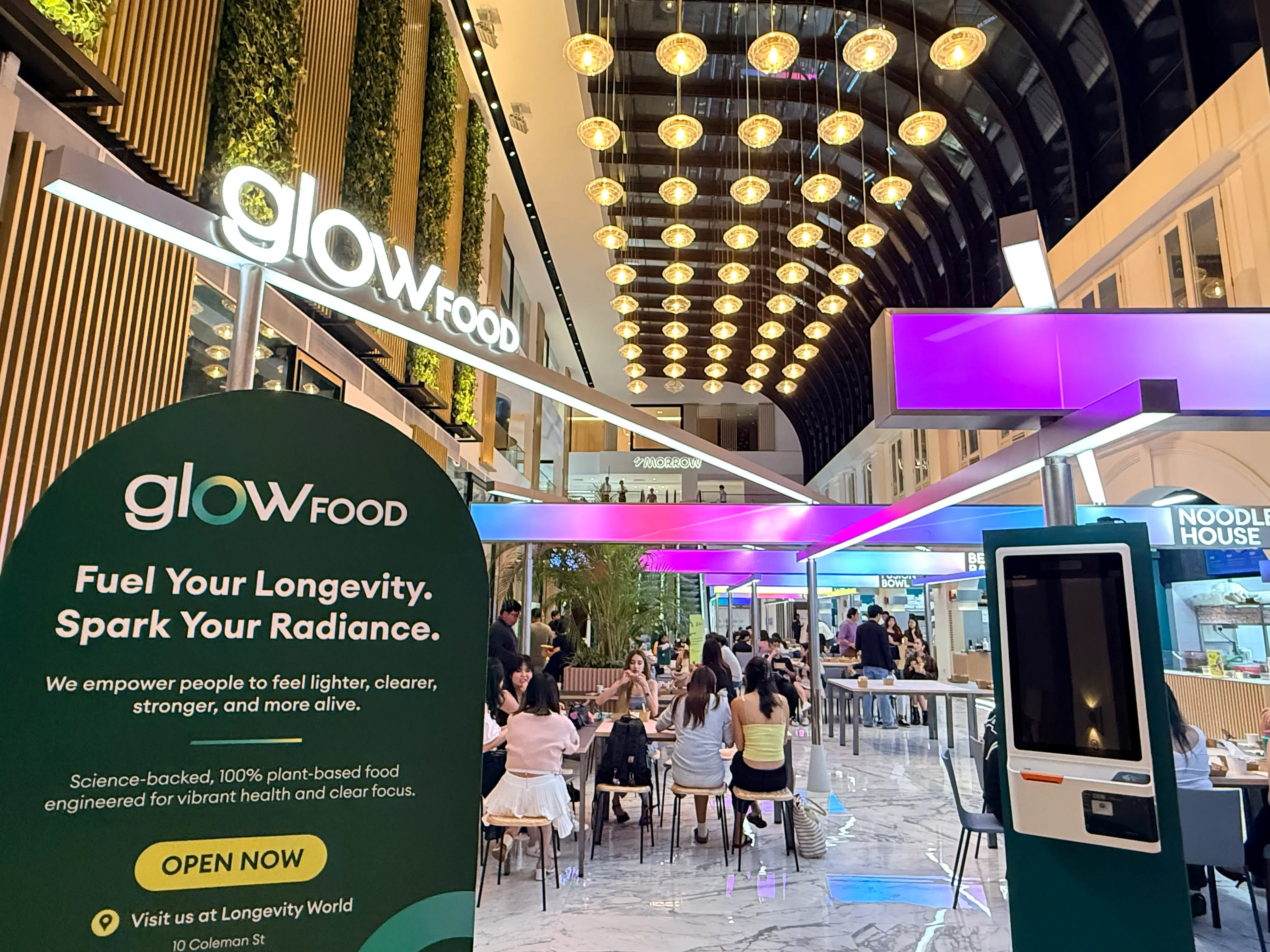

GlowFood touts itself as the country’s first longevity-focused, 100 percent plant-based food hall, with six different concepts – from bentos and salad bowls to noodles and wraps – under one (skylit) roof. We spoke to Taipei-based co-founder Jason Lin to get the lowdown
Singapore isn’t exactly short of places to eat your greens. Vegetarian restaurants, vegan cafés and health-focused chains have steadily become easier to find, while plant-based eating has moved beyond its niche status. So what, exactly, is GlowFood trying to do differently?
Newly opened on the first level of Longevity World on Coleman Street, GlowFood is a 100 per cent vegan food hall that’s a joint venture between Seveno Capital (a venture capital fund founded by MORROW’s Allen Law) and Taiwan’s YM Spring, a five-time Michelin Green Star culinary group run by Jason Lin.
Rather than positioning itself exclusively for committed vegans, GlowFood’s bigger ambition appears to be making plant-based eating an everyday option – something you can grab for lunch whether or not being vegan is part of your identity.
READ MORE: Why MORROW’s Allen Law wants to make longevity less of a rich person’s game

For co-founder Jason Lin, longevity-focused food isn’t simply about putting together a nutritionally virtuous meal.
“Longevity food focus is really a mindset,” he says on a call from Taipei. “It’s about being conscious of what you eat, and how you choose to eat.”
His argument is that most people choose their meals according to familiar criteria: Flavour, convenience, price or ambience. GlowFood wants another consideration on the table – how the food makes you feel afterwards.
The menu is therefore designed around whole-food ingredients, lighter cooking and what the brand calls a five-colour approach, deliberately incorporating ingredients across five colour groups. Its bento bowls use a 16-grain base rather than regular white rice, while sauces and seasoning are intentionally dialled back.
The idea is to leave diners feeling less sluggish rather than requiring a post-meal recovery arc.
But there’s a catch: Food that is designed to be “clean” isn’t necessarily food that everyone finds exciting. Lin is refreshingly candid about this. “It’s just sort of everyday food,” he says. “There’s no surprising element to it, and [the taste profile is] pretty safe.”
He admits, however, that that could be a double-edged sword.
READ MORE: What happens when you go for a longevity screening at MORROW?
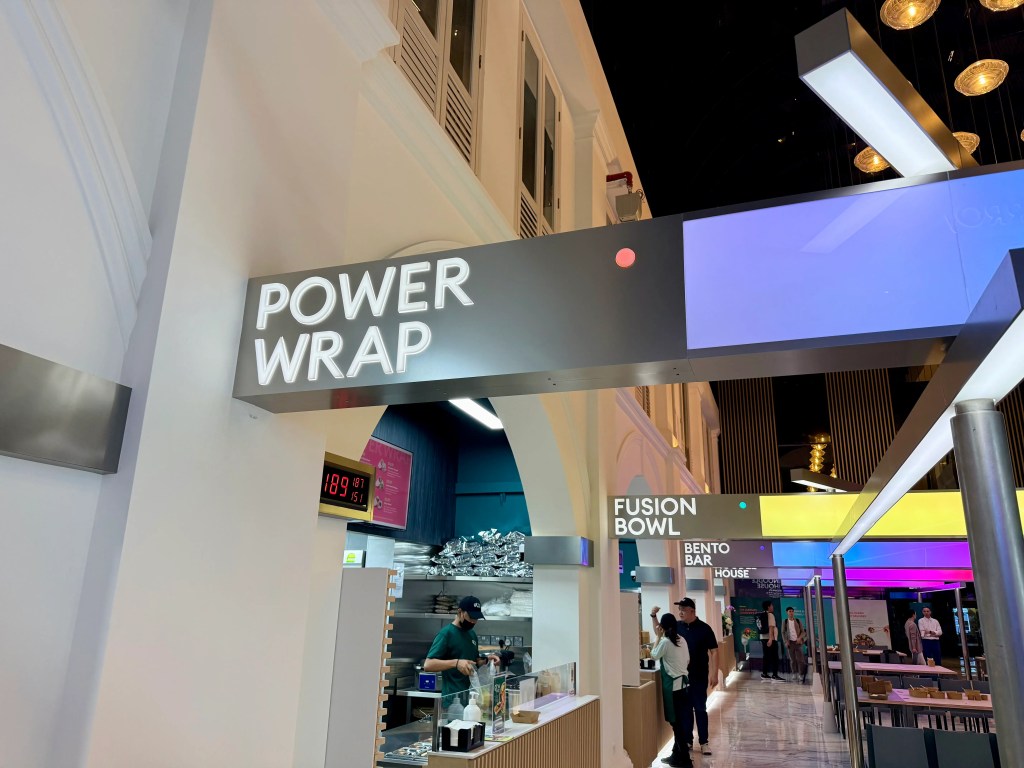
For the hungry and the merely curious, GlowFood is essentially a small food hall containing multiple plant-based concepts: Bowls and bentos, wraps, sandwiches, noodles and other formats designed to work across different cuisines.
The menu includes dishes such as a Red Sauce Meatball Sub, Wizard of Oz Hummus Sandwich, Braised Noodle Soup, Beansprout Salad Platter and Mushroom Bento Box.
Food starts from $12.99, while drinks start from $9.99.
The intent is not to recreate fine dining at fast-casual prices. Instead, Lin says the team has tried to translate YM Spring’s culinary philosophy into food that can be prepared in relatively small kitchen spaces, with relatively simple and scalable processes.
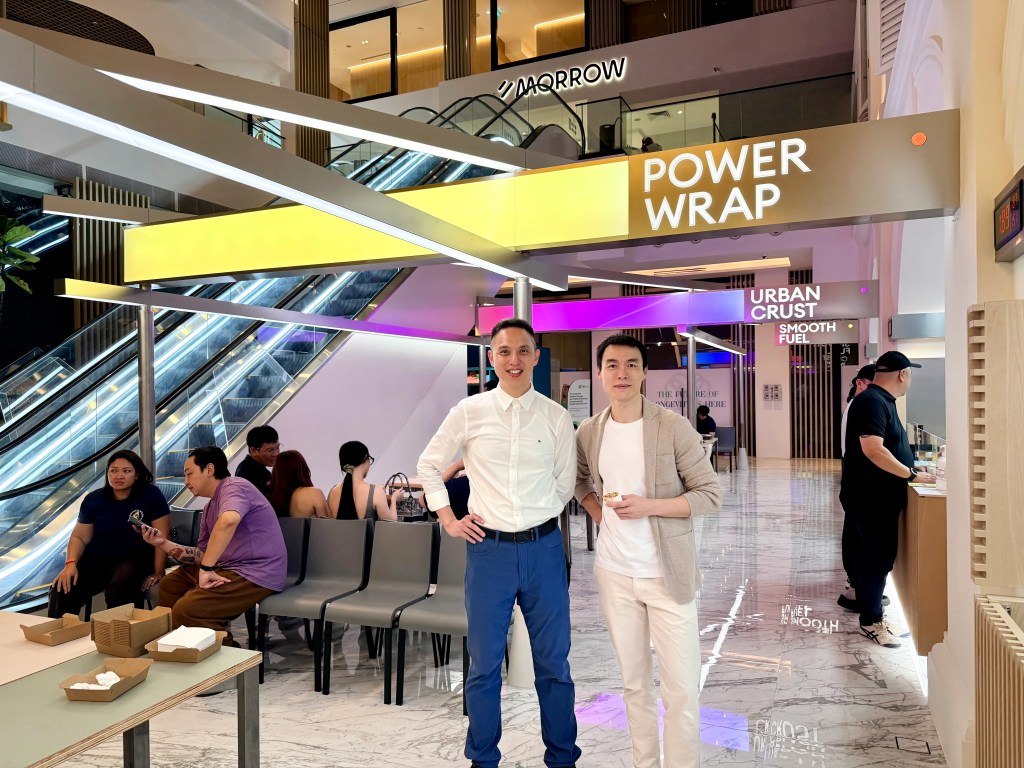
The idea for GlowFood evolved from a much smaller proposition. Lin and his co-founder, Law, initially discussed bringing YM Spring into Longevity World as a single restaurant. But the concept expanded into a food hall with six different stations, offering everything from Western to Asian-inspired food.
There was a practical reason for this. Each unit has limited kitchen space, and the founders wanted a model that wouldn’t depend on highly specialised chefs working behind every counter.
The result is a collection of sub-brands under the GlowFood umbrella – concepts that could eventually be franchised individually, in groups or as a complete food hall.
The ambition is global: Lin talks about potentially taking the model beyond Singapore to markets including Hong Kong and Thailand. In other words, the Coleman Street outlet is less of a finished product than a prototype. And Lin is the first to admit it.
READ MORE: Would you drink matcha made from silkworms? This Japanese startup is betting you will


When The Longevity Project visited in mid-September – a fortnight before its official opening – not all the concepts were operational. Some ingredients were still arriving from Taiwan, and the outlet was only serving lunch while the team continued recruiting staff.
We went in with high expectations, partly because of the Michelin Green Star pedigree. What we found was fresh, wholesome food that, at least in its current iteration, didn’t always feel dramatically different from what you can already find at other salad bars or health-focused chains in Singapore.
Lin acknowledges the challenge. The team, he says, needs to communicate the concept better. And while the food can be made more flavourful relatively easily through seasoning and sauce, he recognises that the mass market isn’t necessarily eating the way he does.
“I’ve been vegan, pure vegan for a few years,” he says. “But again, not everybody’s like me, right? Like super longevity- or super health-focused. So it is a bit of a double-edged sword.”
That may ultimately be GlowFood’s biggest challenge: How do you make food designed for longevity appealing to people who aren’t thinking about longevity when they’re hungry?
At the time of GlowFood’s launch on 30 September, five out of the six concepts were fully up and running, leaving only Noodle House to open. The outlet is pending delivery of a pure vegan soup base from a supplier in China.
“Opening six concepts at once… I probably should have been less ambitious,” he admits.
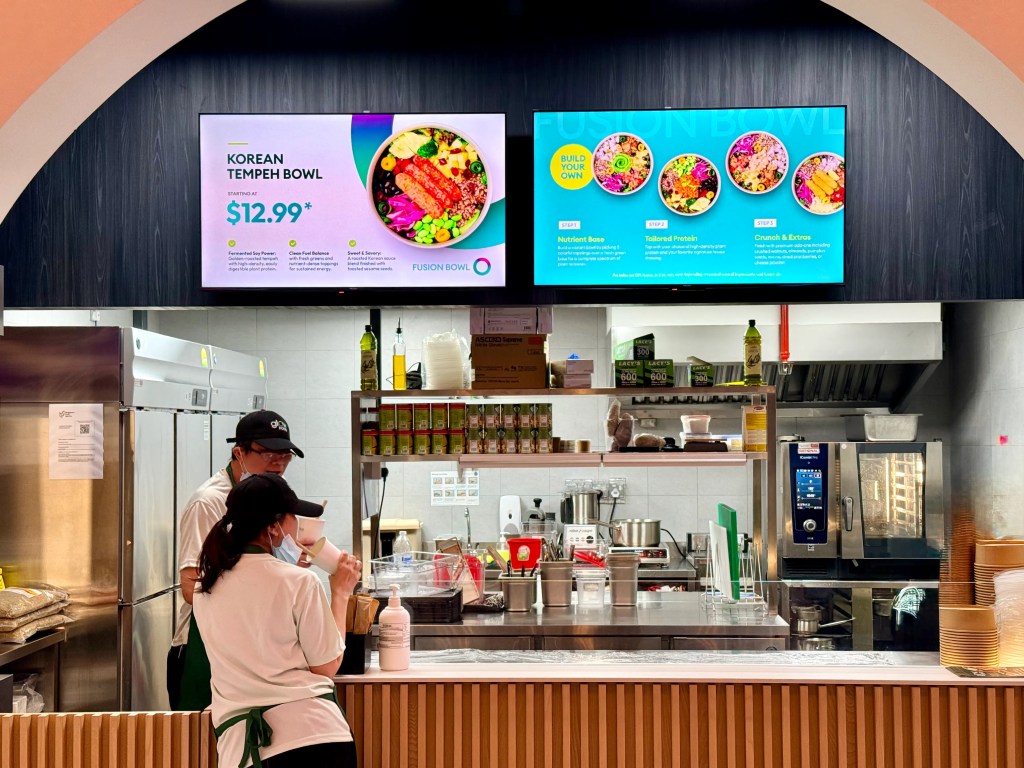
For anyone who has ever tried to hit a specific protein target, the plant-based lunch conversation gets slightly more complicated.
GlowFood’s main proteins are plant-based, while additional mock-meat options – including plant-based beef and meatballs – were still on their way from Taiwan when we spoke.
Lin says the brand is also importing selected sauces, mock meats and other speciality ingredients because the team has not found local alternatives that meet its preferred standards for taste, texture and what it considers health benefits.
It’s an approach that may help differentiate GlowFood, but it also raises a practical question for a business pitching accessibility and scalability: How easy is it to make this model affordable and consistent when some of its signature ingredients have to travel across borders?
For now, that’s another piece of the puzzle still being worked out.
Perhaps the most intriguing part of GlowFood’s proposition isn’t actually on the menu.
Lin comes from a technology background (he founded hospitality sustainability platform HotelZero) and says the team is developing a GlowFood membership app that could track what customers purchase, analyse their nutrition and eventually provide goal-based dietary recommendations.
The idea is to gamify the experience: Eat at GlowFood, work towards health goals and potentially unlock special experiences.
If it works, the food hall becomes the physical front end of something much bigger – a platform connecting what you eat with how you track and manage your health. For now, however, GlowFood is still finding its feet.
Ultimately, is GlowFood a longevity game-changer?
Not just yet, we feel.
But maybe that’s the wrong question. The more interesting one is whether Singapore needs another vegan restaurant – after all, according to a 2023 YouGov survey, only five per cent of Singaporeans follow a fully plant-based diet.
Maybe Singapore just needs a place that can make plant-based food feel so normal, convenient and genuinely enjoyable that you don’t have to be vegan, a wellness obsessive or a longevity nerd to want it for lunch. GlowFood is clearly betting on the latter. Now it just has to make us crave it.
READ MORE: Is Foura, a new wellness-focused restaurant at Gardens by the Bay, worth the hype? An honest review